
What do YMCA Before & After School educators carry to help keep children safe?
Reading time: 3 minutes
Tissues. Bandages. Gloves. Activity cards.
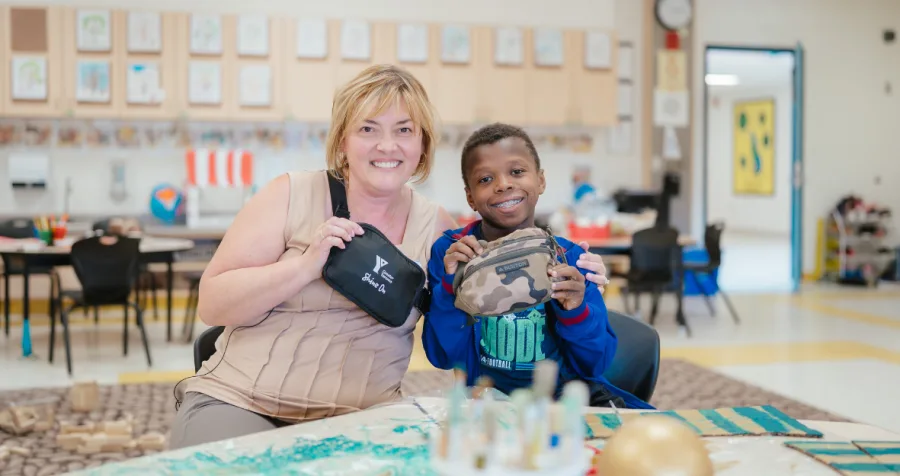
There's a lot tucked inside the belt bag that YMCA Before & After School educator Gorete keeps close throughout the day.
But why carry it everywhere?
At YMCA of Greater Toronto, safety is part of caring for children from the moment they arrive. Educators prepare for everyday situations, from a runny nose to a scraped knee, as well as the individual health needs of the children in their care.
Gorete gave us a peek inside her belt bag. Then Colin joined her to show us something important he needs to have ready, too.
Let's take a look.
1. What's inside Gorete's belt bag?
First up: tissues.
"You never know if we have little runny noses," Gorete explains.
Keep looking and you’ll find hand sanitizer, gauze, bandages, safety pins, gloves, and a small sealable bag.
Each item is there for a reason.
A small scrape might call for a bandage or gauze. If a child has a nosebleed, Gorete might reach for tissues to help clean their nose, hand sanitizer to clean her hands when water isn’t available, and latex gloves to wear while helping the child. A small sealable bag can hold the used tissues and gloves for disposal.
And because Gorete wears the bag as she moves through the day, these supplies stay close while she is caring for children.
For a parent, that small belt bag can tell you something important: preparation travels with the educator.
2. What if a child has an allergy?
That's where Colin comes in.
Colin has an allergy and needs to have an EpiPen available in case of an emergency.
Information about children's allergies is kept where educators can access it throughout the day. Allergy lists are posted in program rooms and kept with attendance records and in program binders. Supervisors make sure educators, including supply educators, know where to find this information and are aware of any updates.
Emergency medication, such as an EpiPen or inhaler, is typically carried by an educator. If a family wants their child to carry their own EpiPen, this is recorded in the child's anaphylactic plan.
While Gorete's belt bag helps her prepare for everyday situations, educators also know where to find important health information and keep emergency medication accessible throughout the day.
3. Safety goes where children go
Children are always on the move.
They head outside, visit the playground or gym, and move between spaces.
Educators go with them.
That's why keeping important supplies close matters. Safety and supervision don't stay behind in the program room when children head somewhere else.
And there's something else in Gorete's belt bag that helps during those moments.
A ring of activity cards.
Gorete uses them during transitions, such as when children are getting ready to go outdoors. The activities help keep children engaged and having fun while everyone gets ready.
4. A lot of preparation fits in a small bag
You might spot an educator wearing a belt bag at drop-off or pickup and never give it another thought.
Now you know a little more about what's inside.
Beyond the bag, educators also pay attention to the individual health and safety needs of children in their care, like Colin.
These are some of the everyday ways safety becomes part of a child's day at the Y.
The belt bag may be small.
The reason for carrying it is anything but.
Learn more about YMCA Before & After School programs
Wondering what else happens during your child's time at the Y?
Explore YMCA of Greater Toronto's Before & After School program and find a location near you.